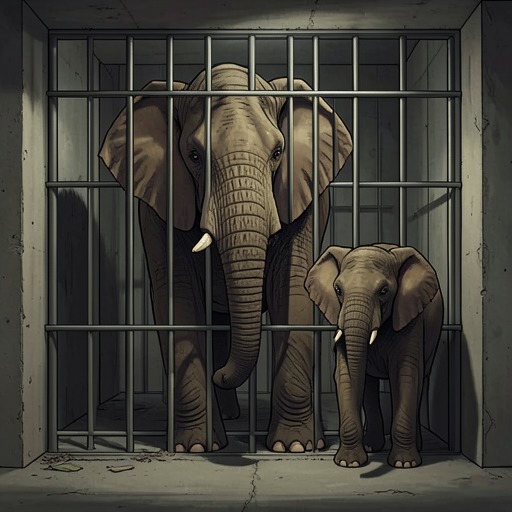
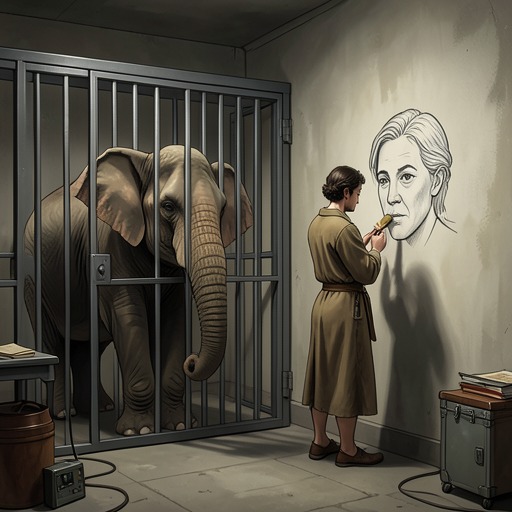
Ivan paints a zoo picture marked “HOME”
The One and Only IvanIvan paints a zoo picture marked HOME as a way to imagine and communicate a safer place for Ruby. What begins with an image on a television screen becomes a deliberate, painstaking project: he studies the elephants’ habitat, paints one piece at a time, and plans a large puzzle with a word at its center. The picture matters because it counters the commercial images surrounding him with a vision of belonging, even as the cages and walls that shape his own life remain in view.
A promise becomes a project
Ivan’s decision to paint takes shape as he looks at the billboard for the Exit 8 Big Top Mall and Video Arcade. It shows him as the One and Only Ivan, with a faded picture of Stella and, later, Ruby added to attract visitors. He remembers Ruby’s story of villagers coming to her rescue and Stella’s belief that humans can sometimes surprise animals. Looking at his red-painted fingers, he understands how he can keep his promise to Stella: he will make an image that might help Ruby.
The work is not a single picture completed in a burst. Ivan waits during the days and paints at night, while worrying when Mack takes Ruby into the ring. Each sheet seems small beside the number he expects to need, so he moves from one to the next. He recognizes the growing work as a giant puzzle whose pieces must be made individually. By morning, paintings cover his floor; he hides them under the dirty water in his pool so Mack will not find them and turn them into merchandise for the gift store. The possibility that his work might be sold for twenty dollars, or twenty-five framed, makes the contrast clear: Ivan is painting toward a purpose that is not simply to entertain visitors or produce another sale.
The image of a different place
The model for Ivan’s picture comes from a television advertisement. He sees a human family looking at another family: elephants, young and old, surrounded by rocks, trees, grass, and space to wander. He notices both what the image offers and what it cannot resolve. The place is a zoo, and he can see its boundary, the wall separating one group from another. Even in the brief advertisement, he recognizes that it is not perfect; in his view, a perfect place would not need walls.
That qualification gives the painting its complexity. Ivan does not mistake an enclosure for an unbounded wilderness. He studies the displayed habitat closely, trying to remember its rocks, trees, tails, and trunks before the advertisement ends. When he looks from the elephants on the screen to Ruby, whom he sees as small and alone, the image becomes more than an attractive scene: it is the specific picture he needs to make for her. The painting’s hoped-for refuge is imperfect, but it suggests space and the company of other elephants, in sharp contrast to Ruby’s isolation at the mall.
Building the puzzle and naming it
Ivan organizes his plan materially as well as imaginatively. He lays out sixteen pieces of poster board, four down and four across, to form a perfect square. The arrangement gives the many separate paintings a shared shape: instead of isolated sheets, they can become one larger image. His choice to make a puzzle also fits the gradual method already established, in which the intended whole can only be assembled from pieces created one by one.
The word is an essential part of that whole. When Bob asks why Ivan needs it, Ivan explains that it will be an important word: Home. Bob quietly says that it is not so important. Their exchange sets two different understandings beside each other. For Ivan, the word names the purpose of the zoo image and the possibility it represents; Bob’s response does not share that emphasis. The narrative does not resolve the difference in that moment. Instead, Ivan’s insistence makes the word a clear statement of what the picture is meant to mean, rather than a mere label for its subject.
Images against walls
The painting develops alongside signs that the animals’ circumstances may change, though the evidence does not make Ivan’s artwork the cause of the inspection process. A property inspector visits and checks Ivan’s floor, Ruby’s hay, and the water bowls. A week later, he returns with a woman in a white coat, who watches Ivan and Ruby before speaking with the inspector and Mack. Later, the woman returns with others and a box sized for Ruby; Ivan realizes that they have come to take her away. The parallel between his painted destination and the real transport box is consequential but unresolved in the moment: both concern movement, while only one is the place of belonging he has imagined.
A large metal box is also placed against Ivan’s doorway, and his cage door is propped open. The new opening leads directly into the box, so an open door does not by itself mean freedom from confinement. Later, on a hilltop, Ivan sees a long, clean white wall stretching toward the habitats beyond his own. It is built to keep the animals in and others out, and he recognizes that he is still in a cage. Against those repeated boundaries, the picture marked HOME holds together a promise and a limit: Ivan can make a different place visible and name what Ruby needs, even while the actual spaces available to them remain controlled by walls, doors, and boxes.